
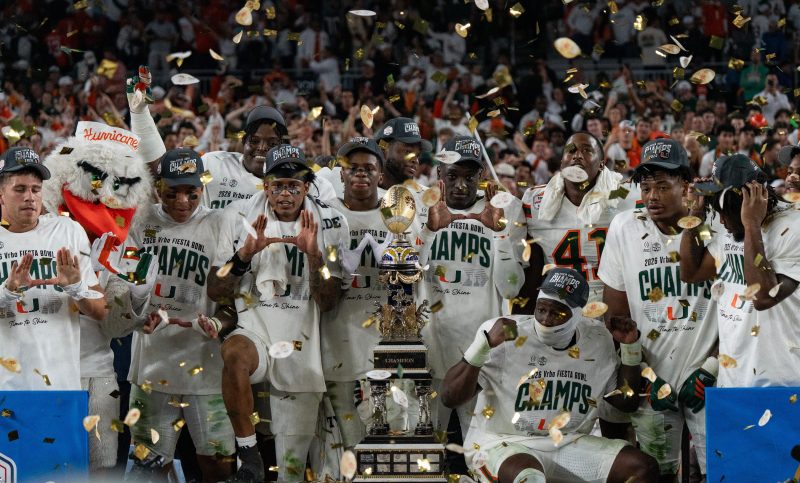
GLENDALE, AZ — Wouldn’t you know it, as we reach peak crazy in the ever-evolving menagerie that is college football, the Miami Hurricanes decided to reintroduce old school nostalgia.
Breathe deep, everyone, and soak in the brief respite from the nouveau riche transitory, cash is king aura of the game while Miami takes you on a wayback tour for the ages.
One that almost died before it could reach a beautiful ending.
The dagger is the game-winning drive that ended with a 3-yard touchdown run from Carson Beck with 18 seconds remaining. The story of Miami’s 31-27 Fiesta Bowl College Football Playoff semifinal win over Ole Miss is so much more than that.
It has been 24 years since Miami last won a national title, 23 since the phantom pass interference call against Ohio State that stole another. Now after more than two decades away from the national elite, Miami has finally returned.
Even if it almost blew it in the process.
‘It’s a reflection of our players and their DNA,’ said Miami coach Mario Cristobal, the former Canes offensive linemen who has spent four years rebuilding and reshaping a team that spent the majority of the 21st century in the college football hinterlands. ‘The tougher it gets, the better we play.’
This is what Cristobal wanted all along, anyway. Too many times over too many seasons in the 2000s, Miami underachieved or oversold, and underdelivered or just plain underwhelmed.
They weren’t tough enough. Didn’t know how to win games that mattered, games that define programs.
They wilted in the moment, and didn’t believe in each other. They weren’t physically or mentally tough enough.
They dodged a near catastrophe when the CFP selection committee nearly chose Notre Dame ― which Miami beat in the season opener and had the same record as the Irish ― and they’ve now won five consecutive games away from Miami.
How fitting that the final game in this journey, the last step of Miami returning to glory, will be the national championship game (against Indiana or Oregon) played at home in Hard Rock Stadium in Miami Gardens.
‘We made a promise to each other that we’d get to this point,’ said Miami safety Jakobe Thomas. ‘It’s go time now, and we coming.’
So while former players with their championship rings of years past crowded the field and celebrated with each other, while former receiver Michael Irvin continued his postseason sideline party by storming around State Farm Stadium and screaming ‘Happy U Year!’, the heavy lifting of it all was in the moment.
Miami dominated nearly every facet of the game. The Canes were the better team, the tougher team. They also were the team that couldn’t get out of its own way with an interception at the Ole Miss 15, 10 penalties, missed scoring opportunities and strange play-calling that ignored a run game that got what it wanted, when it wanted.
So when the game-winning drive began with three minutes to play and Miami trailing 27-24, Beck stood on the sidelines with his teammates and told them, ‘this is what college football is all about.’ Canes offensive coordinator Shannon Dawson then leaned in and summed up the rare opportunity.
‘This (expletive) ain’t easy, but we’re built for it,’ Dawson told the offense. ‘Now go get it.’
A year ago at this time, Beck was recovering from ulnar surgery on his elbow and sitting at his home in Jacksonville. He wasn’t leaving for the NFL, and wasn’t returning to Georgia.
Across from him was Cristobal, with a plan and a vision to not only return Miami to the top of the mountain ― but to do it with Beck as his quarterback. A year later, it came down to Beck and the final drive of the Fiesta Bowl.
‘I looked at the guys and said, ‘These are the big moments,” Beck said. ‘Are we going to respond or not?’
This is how Cristobal envisioned the return of Miami. This is what he knew it could look like once the right players were recruited, the right coaches were hired and a never-fear, never-flinch culture was born and developed.
All of those Miami teams of the past that would’ve wilted in this moment, all of those teams that followed the greatest team in college football history in 2001 that couldn’t close out games, couldn’t make their mark. That includes the 2024 team, a group that could’ve reached the CFP but lost two of its last three games and finished playing in a meaningless bowl game.
As the confetti fell late Thursday night, as the realization of what had transpired and where it was headed had settled in, former Miami quarterback Cam Ward stood outside the stage on the field and smiled. They were so close in 2024, but the buildout wasn’t complete.
‘This team took what we built, and took it to another level,’ Ward said.
The Canes did it by going old school, by lining up and physically punishing Ole Miss on both sides of the ball. At this point, who cares if they nearly gave away the game, if it took a 75-yard drive to pull it off.
Miami is back among the national elite because Cristobal’s plan from Day 1 has worked. Even in the face of nearly blowing it all in the most important game of the season.
You remember the good ol’ days, don’t you? When players weren’t paid (legally, anyway), universities hoarded the cash and free movement of players was from the starting lineup to the bench.
And when Miami, with the best players and coaches, did whatever it wanted in a two-decade run that rivaled anything the sport had ever seen. Until a guy named Saban came along.
But this Miami team has plenty of Nick Saban in it, and more of what made Miami great — and led to five national titles from 1983-2001. Cristobal played at Miami under Jimmy Johnson and won a national title, and coached under Saban at Alabama and won another.
He’s now returned Miami to the elite of the game, and on the verge of ending that national title drought. By taking the formula Johnson used and Saban perfected, and imposing its will on anything and anyone in its way.
A formula so perfected, it even perseveres through human error.
‘We let our play on the field answer any and all questions,’ Cristobal said.
All the way to the national championship game.