
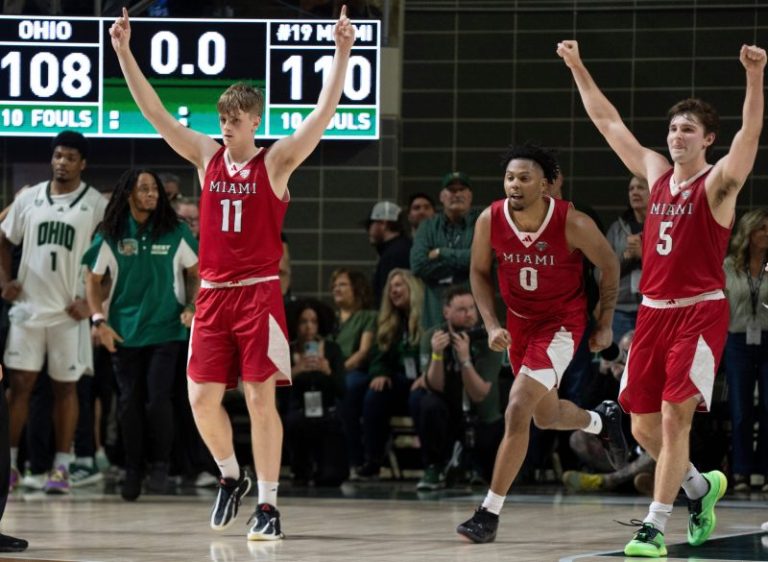
Let me take you back a quarter century or so, when Wally Szczerbiak was the baddest man in the NCAA Tournament.
When Miami (Ohio) in 1999 became one of the original underdogs of what has annually become the greatest weekend in sports.
When there was controversy then, too, about MAC regular-season champion Miami receiving an at-large bid to the NCAA Tournament after losing in the MAC tournament championship.
The same potential argument unfolding with this year’s Miami team — with one caveat.
This team is 31-0.
The RedHawks of yesteryear hopped on Szczerbiak’s back and beat No. 7 seed Washington and No. 2 seed Utah in the first weekend of the NCAA Tournament, before eventually losing a week later in the Sweet 16.
But here’s the key, and the connection to 2026: that Miami team beat No.7-ranked (and eventual No. 4 seed) Tennessee in the regular season. Also won at Notre Dame.
This Miami team has beaten no one of significance, leaving the tournament selection committee with a difficult question to answer should Miami lose in the MAC tournament.
Is Miami one of the 68 best teams in college basketball?
While you stare at Miami’s spotless record, and the rare air it produces, let me offer a few more numbers to digest.
Miami’s nonconference schedule rank by the KenPom rating service is 361. And I don’t want to burst any bubbles here, but there are 365 Division I teams.
Miami played 15 Quad 4 games, the lowest level of the quad games formula. The RedHawks didn’t play a single Quad 1 game.
Miami played — I swear I’m not making this up — three teams called Trinity Christian, Indiana East and Milligan. No to be confused with, you know, mulligan.
All three are NAIA schools, and because no one wanted to play Miami and its upperclass-laden team — that’s the excuse, for what it’s worth — the RedHawks decided to troll the Appalachian Athletic Conference for leftovers.
Let’s be honest, the Top 25 high school teams would roll the Appalachian Athletic Conference.
Miami, which plays UMass on Thursday morning in the MAC quarterfinals, has won seven one-possession conference games. The MAC, according to the NET rating, is the 17th-ranked Division I conference.
Once you get past the first seven conferences, you’ve reached the one-bid leagues. The MAC currently is looking up at the Big Sky, Big West and Coastal Athletic, to name a few.
So this comes down to perfection vs. the path to perfection.
How many of the 365 Division I teams could pull off the same 31 straight wins if they played Miami’s schedule? More than you think. Don’t get pulled into the argument that an unbeaten season has to mean something.
It doesn’t.
Especially if it was built by feasting on the worst of the worst of college basketball. Miami’s overall schedule rank according to KenPom is 231.
Two hundred thirty one.
This isn’t necessarily an argument for Auburn or Indiana or Stanford or Cincinnati or any other Power conference team getting hosed. It’s more about the New Mexico, San Diego State and Santa Claras of the world teetering on the edge of the bubble.
They’re potentially out if they don’t win their conference tournaments, and Miami is in because it was lallygagging through a ridiculously soft schedule designed for success. But because the RedHawks have managed to keep the core of a solid team on campus, a team full of game experience, we should genuflect and never question a team with an unbeaten record.
Why, you ask? Well, do you know how hard it is to go unbeaten?
Not that difficult when you’re playing the 231st-ranked schedule.